Myths series
AI analyzes candidates' emotions — true or false?
Myths series · Article 8/10
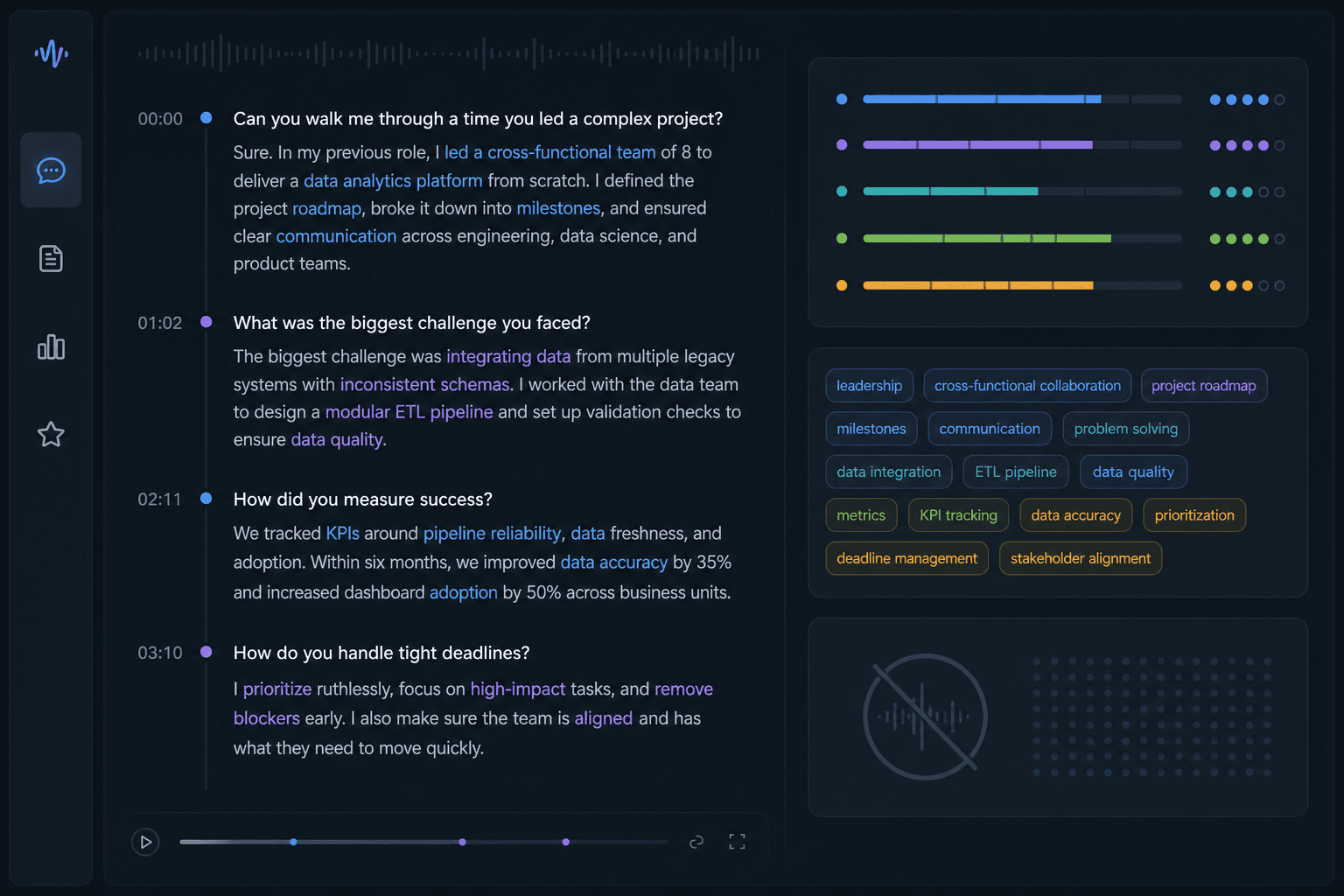
Media demos of AI reading fear, stress, or confidence from a face or voice created legitimate concern among candidates and DPOs. In hiring, the technology is not only scientifically disputed — it is now heavily restricted, even banned, under the EU AI Act.
Serious professional solutions do not guess personality or emotional state: they transcribe what you say and assess it against predefined job criteria. The line between semantic content and emotional inference is not a technical detail — it is a compliance criterion.
Before choosing a tool, ask vendors eight specific questions. Answers separate responsible providers from worrying gadgets.
What people say
« AI analyzes candidates' emotions. »
In practice
Compliant hiring tools do not infer emotions: they assess answer content against job criteria — the AI Act bans emotion inference in relevant workplace contexts.
Media myth vs product reality
Emotion recognition AI relies on fragile correlations between facial expressions or vocal parameters and inner states — challenged by cross-cultural research (context, gender, disability).
In hiring, inferring joy, anger, or nervousness to score candidates is both unreliable and legally exposed. Responsible vendors explicitly exclude this in technical documentation.
AI Act restrictions on emotion inference
The AI Act bans AI intended to detect or infer emotions in the workplace and educational settings — except narrow medical or safety exceptions.
Pre-screening for employment falls in this logic: exploiting vocal stress to eliminate candidates exposes deployer and provider. Confirm contract and product docs explicitly exclude this functionality.
- Banned: scoring on inferred stress, confidence, enthusiasm.
- Allowed: factual content assessment from transcribed answers.
- Gray zone to avoid: prosody or pace analysis as personality proxy.
- Require written vendor declaration of signals used.
What Lucy actually scores
HiLucy transcribes the voice interview and compares answers to recruiter-defined criteria: years of experience on a technology, project examples (STAR method), availability, mobility, stated salary expectations.
The score reflects coverage of job criteria in the transcript — not voice tone, accent, pace, or supposed emotion. If a candidate clearly states a skill, it is captured; if not mentioned, the criterion remains unmet.
Recruiters can read source excerpts and challenge the score — traceability is semantic, not psychological.
Transcript vs tone: where to draw the line
Speech-to-text converts spoken words to text. Analysis then targets that text: job keywords, example structure, answer completeness.
What HiLucy scoring excludes: vocal timbre, hesitations as lack of confidence, lie detection, Big Five personality typing, vocal attractiveness.
Vendor questionnaire: 8 questions to ask
Before signing, send this questionnaire to any vendor — including when comparing HiLucy to alternatives.
- 1. What exact signals feed the score (text, raw audio, video)?
- 2. Do you use emotion inference or behavioral biometrics?
- 3. Can you provide the exhaustive list of variables excluded from scoring?
- 4. Can the candidate obtain a understandable explanation of their evaluation?
- 5. Where is audio hosted and how long is it retained?
- 6. Can a human modify or cancel the score — and is it logged?
- 7. Do you have AI Act conformity assessment / Annex III documentation?
- 8. What happens if we disable certain analysis features?
How to verify internally
Request a demo with a test interview: confirm the summary cites text excerpts, not emotion labels (nervous candidate). Have your DPO validate the sheet.
If the vendor answer is vague, treat it as a red flag — not a commercial detail.
Key takeaway
Hiring assesses expressed competence — not emotions: demand semantic transparency and reject any affective or biometric scoring.
Frequently asked questions
Does hiring AI read candidate emotions?
Serious professional solutions do not analyze emotions. They evaluate answer content against predefined job criteria.
Want to move from reading to action? See how Hi Lucy automates your voice AI interviews and your approach to interviews powered by artificial intelligence.