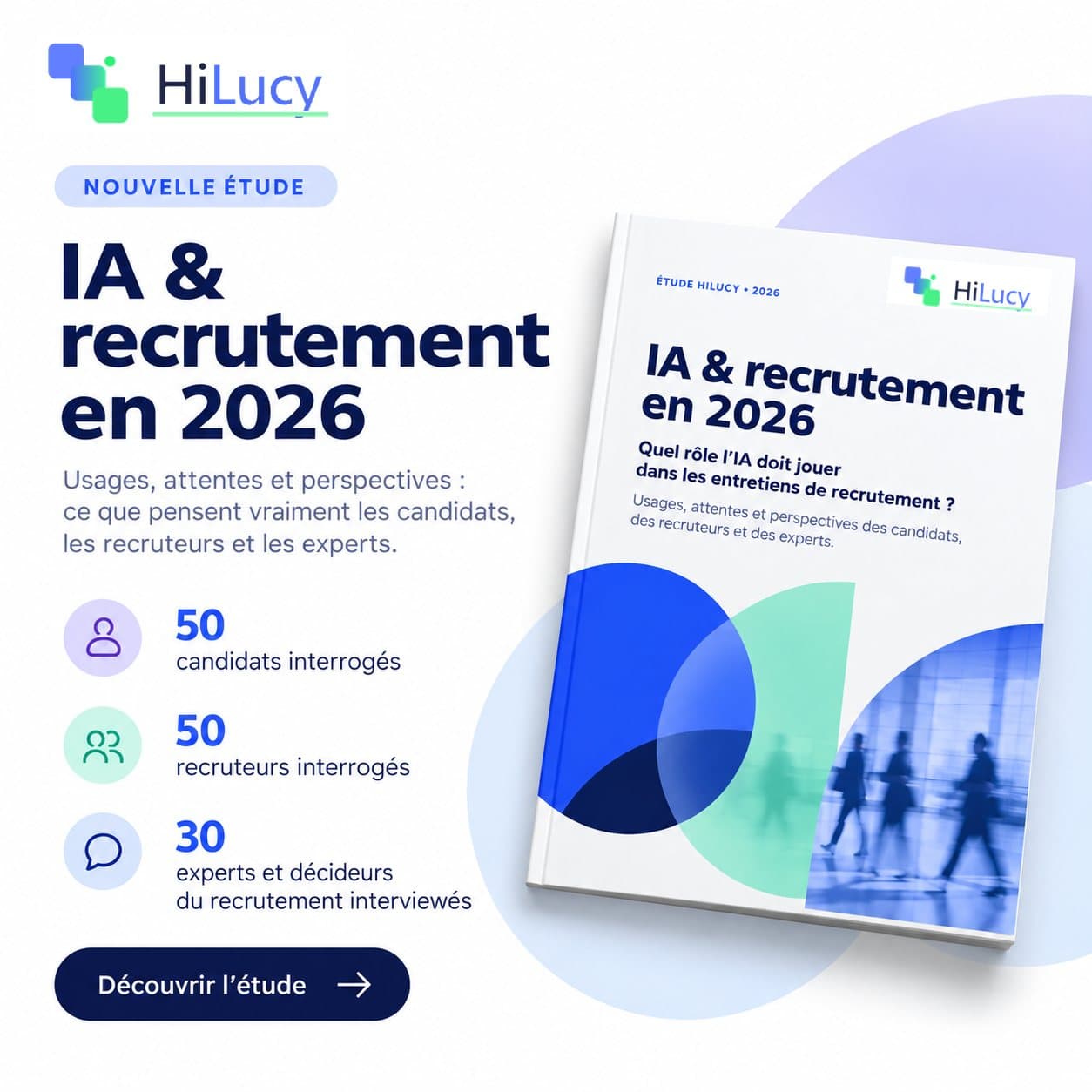
AI & recruitment in 2026
What role should artificial intelligence play in job interviews?
Usage, expectations and outlook: what candidates, recruiters and recruitment experts really think.
Free PDF · 16 pages · in French
Why this study?
Artificial intelligence is already transforming recruitment: sourcing, job ad writing, CV matching, interview preparation, transcription, reporting. Tasks once done entirely by recruiters are progressively automated or augmented by AI.
But when it comes to the interview itself, the question gets more sensitive. Can a first screening be entrusted to an AI? Are candidates ready to talk to one? How far are recruiters willing to delegate? And above all: what place should humans keep?
The central question: when does AI genuinely improve the candidate experience and the recruiter's work?
To cross perspectives, the study combines quantitative surveys (50 candidates, 50 recruitment professionals) with 30 one-to-one interviews with recruitment experts and decision-makers.
What the numbers say
A few of the results detailed in the study.
of candidates would accept a first interview with an AI if it meant getting an answer faster
would be more inclined to apply if the first interview were available immediately
would accept their answers being analysed by an AI if how it works were explained transparently
of recruiters already use AI regularly or have built it into their process
of recruiters already use an AI during the interview phase
of recruiters are not yet ready to hand their first interviews to an AI
The 5 key takeaways
- 01
AI is already part of everyday practice
48% of candidates say they used an AI in their latest application. On the recruiter side, 62% use AI regularly or have built it into their process; 31% already use it during the interview phase.
- 02
Candidates are more open than you would think
63% would accept a first interview with an AI if it meant a faster answer. 78% would be more inclined to apply if the interview were available immediately.
- 03
The higher the volume, the more relevant AI becomes
The interviews show that openness varies a lot with application volume, seniority, industry and the nature of the role.
- 04
Candidate experience is the core expectation
Candidates want above all a smooth, transparent and human process: human contact, clarity, speed and personalised feedback come first. AI becomes acceptable when it tangibly improves that experience.
- 05
Pre-screening emerges as the next adoption ground
AI is already used around the interview. The next step is handling a first screening, while leaving the decision and high-value conversations to the recruiter.
Voices from the study
« Thanks to AI, what comes back to the centre is the human. »
« People prefer an AI to no answer at all. »
« Don't be afraid of AI: go for it, adapt, and see how it can save us time. »
The 4 conditions for adoption
The barriers cited in the study are first about trust. For AI to find its place in interviews, four conditions stand out clearly.
Transparency
Tell candidates when and how the AI is involved. Clear information strengthens acceptance and trust.
Human oversight
Keep a human in the evaluation and the decision. AI is seen as support, not a substitute for the recruiter's judgement.
Reliable, high-quality evaluations
Clear evaluation criteria and fair results are essential to build trust.
Respect and protection of data
Rigorous handling of personal data is indispensable, especially in a demanding regulatory context.
AI does not replace the interview.
It changes what we expect from the interview — and what we expect from the recruiter.
Get the full study
16 pages of results, quotes and analysis (in French). Leave your work email: the PDF opens right away and you receive the link by email.
Free PDF · 16 pages · in French
What if your first interviews were available 24/7?
HiLucy runs pre-screening interviews by voice, in your candidates' language, and hands your recruiters a scored summary.