Strategy & ROI
Behavioral and emotional analysis in interviews: myth or reality?
“AI reads the candidate's emotions” has become a marketing line almost as common as “AI replaces recruiters.” Both set unrealistic expectations — and legal risk — for talent teams that simply want to assess soft skills at scale.
The reality is more nuanced: useful behavioral analysis in hiring does not claim to guess hidden feelings. It structures what is observable — answer content, clarity, engagement, vocal delivery signals — and ties it to job criteria defined upfront.
At a glance
- Myth: AI detects emotions like a psychologist or lie detector.
- Reality: AI can objectify professional communication and behavior signals, with clear evidence and limits.
- HiLucy: structured voice interviews, soft-skills scoring, and evidence-backed behavioral flags — decision support, not automated verdicts.

Myth #1: AI “reads” your emotions
In vendor pitches, “emotional analysis” often implies facial recognition, voice tone interpreted as stress or deception, or opaque personality scores. In hiring, these approaches raise three major issues:
- Weak predictive validity for job performance from isolated facial expressions.
- Discrimination risk (accent, disability, fatigue, different communication cultures).
- GDPR and EU AI Act compliance: high-impact decisions require transparency, justification, and human oversight.
European regulators and HR practice guides align on one point: automated assessment must stay explainable, contestable, and proportionate. Opaque “emotion reading” does not meet that bar.
Reality: what behavioral analysis can cover
Credible behavioral analysis in interviews typically combines:
- Answer content (STAR examples, depth, job relevance);
- Communication quality (structure, clarity, listening);
- Delivery signals in voice interviews: pace, hesitation, perceived engagement, consistency across answers — always role-linked.
This is not clinical psychology: it is structured evaluation support, comparable across candidates, aligned with criteria you validated with hiring managers.
How HiLucy is different
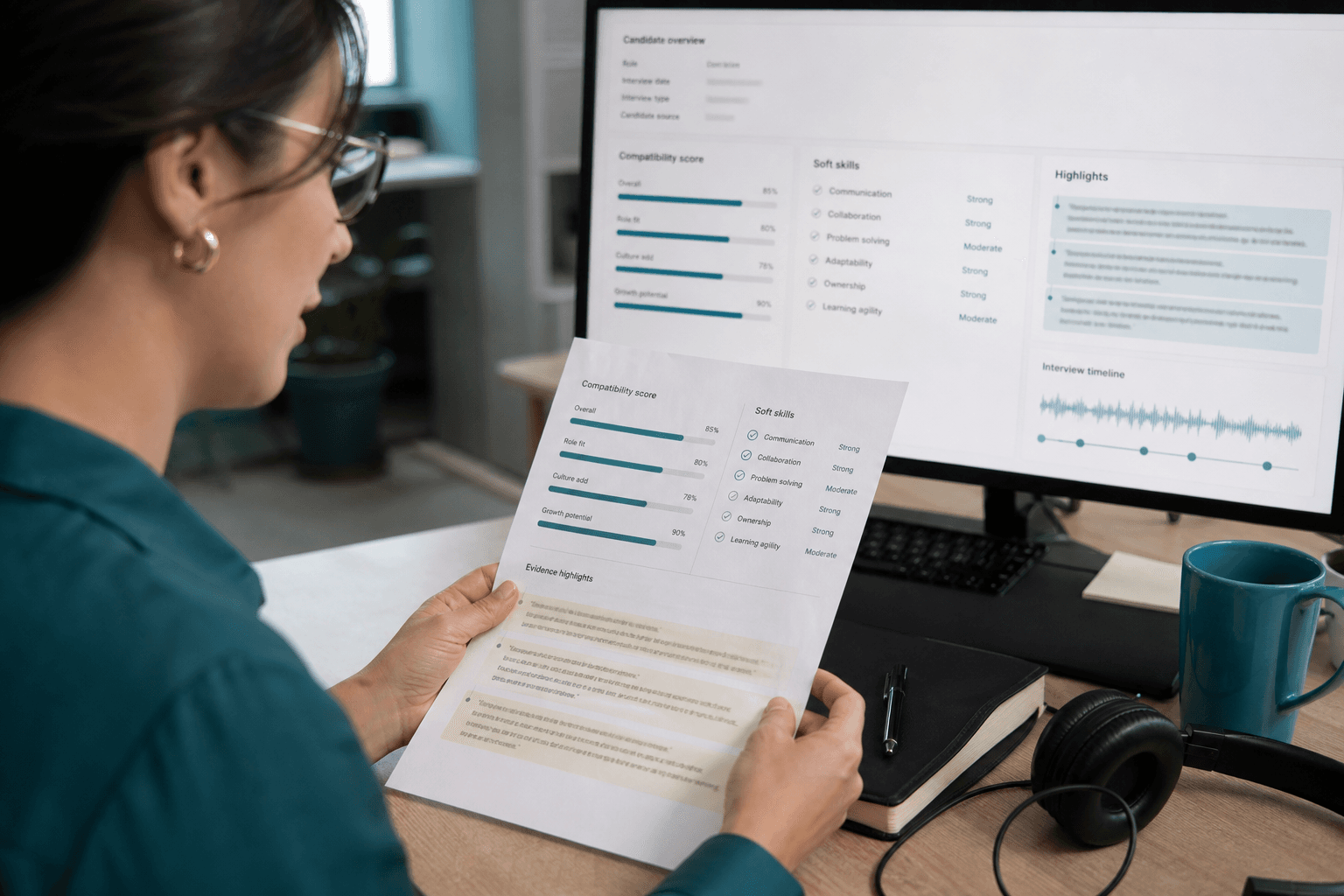
HiLucy does not sell an “emotion detector.” The platform combines voice or text interviews led by Lucy, technical and soft-skills scoring on your rubric, and — for clients who enable it — delivery analysis that synthesizes transcript and prosodic metrics.
Recruiters receive a structured report: compatibility score, AI summary, points to explore, and where enabled behavioral flags backed by textual evidence (answer excerpt, observation on tone or pace), not vague labels like “anxious candidate.”
- Async voice interviews: candidates respond on their schedule; you compare on the same question set.
- Soft skills scored against your criteria (communication, adaptability, client posture, etc.).
- Behavioral flags: informational or watch items, always justified.
- Human decision: AI recommends; recruiters decide.
Myth #2: more voice data = better decisions
Collecting metrics (speech rate, pauses, pitch) without a job frame creates noise. The right question is not “what do they feel?” but “does how they answer match role requirements?” — e.g. sales clarity, calm under pressure for support, or ability to explain complex topics for teaching roles.
HiLucy anchors analysis to the role and scorecard: a weak signal on an introverted profile is not an automatic rejection; it triggers a follow-up question in the manager interview.
Good practices to stay credible (and compliant)
- Tell candidates the interview may be AI-led and AI-analyzed, with human review.
- Publish evaluation criteria tied to the role, not out-of-scope personal traits.
- Require evidence for every behavioral flag surfaced.
- Keep a human interview for final decision and closing.
- Audit false positives/negatives by cohort (seniority, language, disability).
Conclusion: marketing myth, operational reality
Behavioral and “emotional” interview analysis is a myth when vendors promise to read people's inner states. It is a reality when you measure observable professional behaviors on explicit criteria, with evidence and human validation.
That is HiLucy's positioning: structured voice interviews, scored soft skills, justified behavioral signals — faster hiring without sacrificing quality or compliance. For bias reduction, see our article on cognitive biases in recruitment.
Explore Lucy voice interviews or the HiLucy AI recruitment platform.
Frequently asked questions
- Is emotional analysis banned in Europe?
- It is not an absolute ban on the word “emotion,” but high-impact uses (opaque profiling, invasive biometrics) are heavily regulated. Prefer transparent tools with human control and a clear job-related purpose.
- Does HiLucy replace recruiter judgment?
- No. Lucy speeds pre-screening and standardizes evidence; recruiters and hiring managers keep the hire/no-hire call.
- How is this different from a plain transcript?
- Transcripts alone do not structure comparison. HiLucy cross-references answers, criteria, synthesis, and — when enabled — delivery analysis to produce an actionable report in minutes.
Want to move from reading to action? See how Hi Lucy automates your voice AI interviews and your approach to interviews powered by artificial intelligence.