Strategy & ROI
The future of recruitment: towards fully automated interviews?
“Fully automated interviews” sells keynote tickets — and scares candidates. The real leadership question is not whether automation will spread, but how far it should go to free capacity, improve quality of hire, and keep the process legitimate.
This article sets a realistic 3–5 year vision: observable trends, structural limits, the hybrid model that wins, and what ambitious organisations should anticipate now.
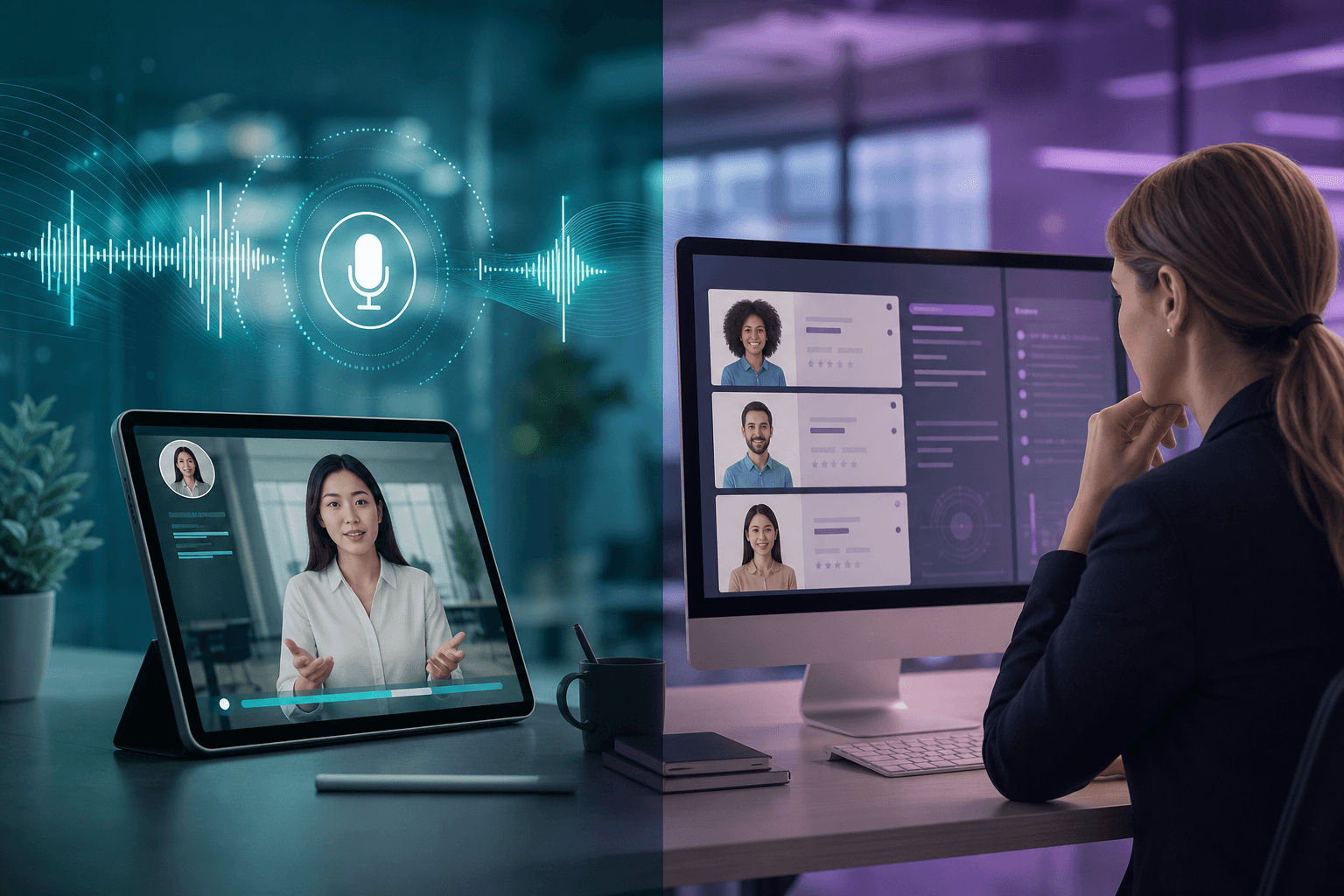
The future of hiring is not “recruiterless”. It is recruiters without repetitive tasks — focused on judgment, negotiation, and candidate experience where humans still create disproportionate value.
Our thesis
By 2030, most high-volume hiring (retail, BPO, logistics, early-stage tech screens) will run fully asynchronous pre-screening and first interviews — AI-led, criteria-based, human-reviewed before any final decision. High-stakes relational or strategic roles will stay deeply hybrid.
Why the “100% automated” debate keeps returning
Three forces converge: time pressure, mature voice and text models, and candidate expectations for fast, transparent journeys.
Talent teams receive more applicants with less bandwidth per role. Candidates compare your process to e-commerce: immediate, mobile, 24/7. Async and voice AI addresses both tensions better than phone-slot scheduling.
But “100% automated” mixes two different realities: automating interview delivery (questions, follow-ups, transcription) and automating the decision (hiring with no human). The first is advancing fast. The second hits legal, ethical, and quality-of-hire walls — see our piece on GDPR and the AI Act in recruitment.
Five trends reshaping the market
1. Async interviews become the volume standard
Candidates respond on their schedule; recruiters compare homogeneous profiles on the same question set. The gain is not only time — it is comparability and less scheduling bias (morning slot vs end of day).
2. Voice AI crosses the acceptability threshold
Conversational agents are fluent enough for structured 15–25 minute interviews. Differentiation is no longer synthetic voice quality — it is script design, criteria, and reporting.
3. From CV to evidence dossier
Mature employers assess situated answers, skill demonstrations, and justified behavioural signals — not a LinkedIn summary interpreted in five minutes.
4. Compliance as a buying criterion
GDPR, AI Act, candidate transparency: opaque tools lose RFPs. Compliance is go-to-market advantage, not legal fine print.
5. The recruiter becomes orchestrator
Less scheduling, more scorecard calibration, edge-case arbitration, and hiring-manager partnership — a shift we explored in AI and hiring: revolution or evolution.
What will be automated — and what will not
| Stage | Strong automation | Human essential |
|---|---|---|
| Initial sourcing | Matching, CV scoring, nudges | Executive outreach, network, employer brand |
| Pre-screening | AI voice/text interview, scorecard, summary | Atypical profiles, sensitive cases |
| Technical interview | Async tests, auto-grading, adaptive Q&A | Architecture, critical design, pair programming |
| Final interview | Briefing pack, flags to probe | Nuanced culture fit, closing, package negotiation |
| Hire decision | Recommendation, alerts, internal benchmark | Manager sign-off, political HR arbitration |
Clear takeaway: a “zero human” scenario is unlikely for high-impact roles. “Zero human on repetitive top-of-funnel tasks” is already underway — and accelerating.
The winning model: automate protocol, human judgment on exceptions
Leading organisations are not trying to remove recruiters. They industrialise what should be standardised: same questions, same criteria, same evidence, same timelines for every candidate. Humans step in where variance matters — non-linear careers, rare roles, negotiation, brand representation.
This is what we see among HiLucy's strongest adopters: a voice or text interview led by Lucy, a structured brief (scores, summary, flags to investigate), then a manager interview focused on uncertainty — not a full repeat of pre-screening.
The detailed AI vs human recruiter comparison is in AI vs human recruiter: who evaluates better?.
Leadership: what executives should anticipate
- Invest in framing before tools: scorecards, observable criteria, pass thresholds — otherwise AI amplifies chaos.
- Train hiring managers to read AI output (summary + evidence), not only a score.
- Measure differently: time to shortlist, candidate completion rate, six-month quality of hire — not cost per hire alone.
- Communicate externally: candidates accept AI when the journey is explained and fair.
- Segment by role: volume = heavy automation; leadership = hybrid; they do not follow the same curve.
In three years, not offering async pre-screening on a volume role will feel like not offering online checkout in 2015: technically possible to skip, commercially baffling.
Scenarios by 2030
Cautious scenario
AI stays limited to sourcing and scheduling. Interviews remain mostly synchronous and human. Limited gains; candidate frustration persists on volume roles.
Central scenario (our view)
Automated pre-screening and early rounds on 60–80% of hiring. Humans on closing and exceptions. ATS platforms natively embed voice agents and evidence dossiers.
Extreme scenario
End-to-end attempts without humans on some standardised jobs — slowed by law, unions, and quality of hire. Niches (micro-tasks, gig platforms) experiment; qualified labour markets stay hybrid.
Where to start this year
Leadership is not announcing the death of recruiters. It is running a measured pilot on a recurring high-volume role, with explicit criteria and systematic human review. Our pre-screening automation guide covers the method; AI voice interviews are the most mature format today.
The future is not 100% automated. It is intelligently automated — and organisations that understand that now will build the talent advantage of the next decade. See how HiLucy fits this trajectory.
Want to move from reading to action? See how Hi Lucy automates your voice AI interviews and your approach to interviews powered by artificial intelligence.