Myths series
GDPR bans AI interviews — true or false?
Myths series · Article 5/10

GDPR is often cited to block every voice AI interview project: we are not allowed to process candidate data with AI. That reading confuses prohibition with governance — and stalls deployments that are feasible with a clear framework.
Data from AI interviews — audio, transcripts, evaluations — is ordinary personal data. Processing is lawful when you follow GDPR principles: purpose, minimization, storage limits, security, data-subject rights, and an appropriate legal basis. Hundreds of European companies already do this.
Your DPO is not a blocker if you arrive with a structured project sheet: purpose, Art. 6.1.b basis, retention, processor clauses, and Art. 22 analysis.
What people say
« GDPR bans AI interviews. »
In practice
GDPR does not ban AI interviews: it requires transparency, legal basis, minimization, candidate rights, and safeguards on automated decisions.
What GDPR requires — not what it forbids
The regulation contains no article specifically banning AI in hiring. It governs personal data processing regardless of tool — ATS, paper form, or voice AI.
The issue is implementation quality: candidate information, DPA with the vendor, updated processing register, and realistic retention policy.
Blanket refusal for GDPR reasons without documented analysis paradoxically leaves informal, less traceable processes in place.
Legal basis: Article 6.1.b in hiring
For pre-screening in a recruitment process, the most common basis is Article 6.1.b — steps at the applicant's request prior to a contract. The candidate applies or accepts the invitation: they ask to be assessed for a role.
Legitimate interest (6.1.f) may apply in some internal or mobility contexts but is harder to justify in external hiring. Avoid consent (6.1.a) as the primary basis: it must be freely given, and candidates cannot be forced to accept under threat of elimination.
Document the chosen basis in your register and candidate privacy notice.
Article 13: information list before the interview
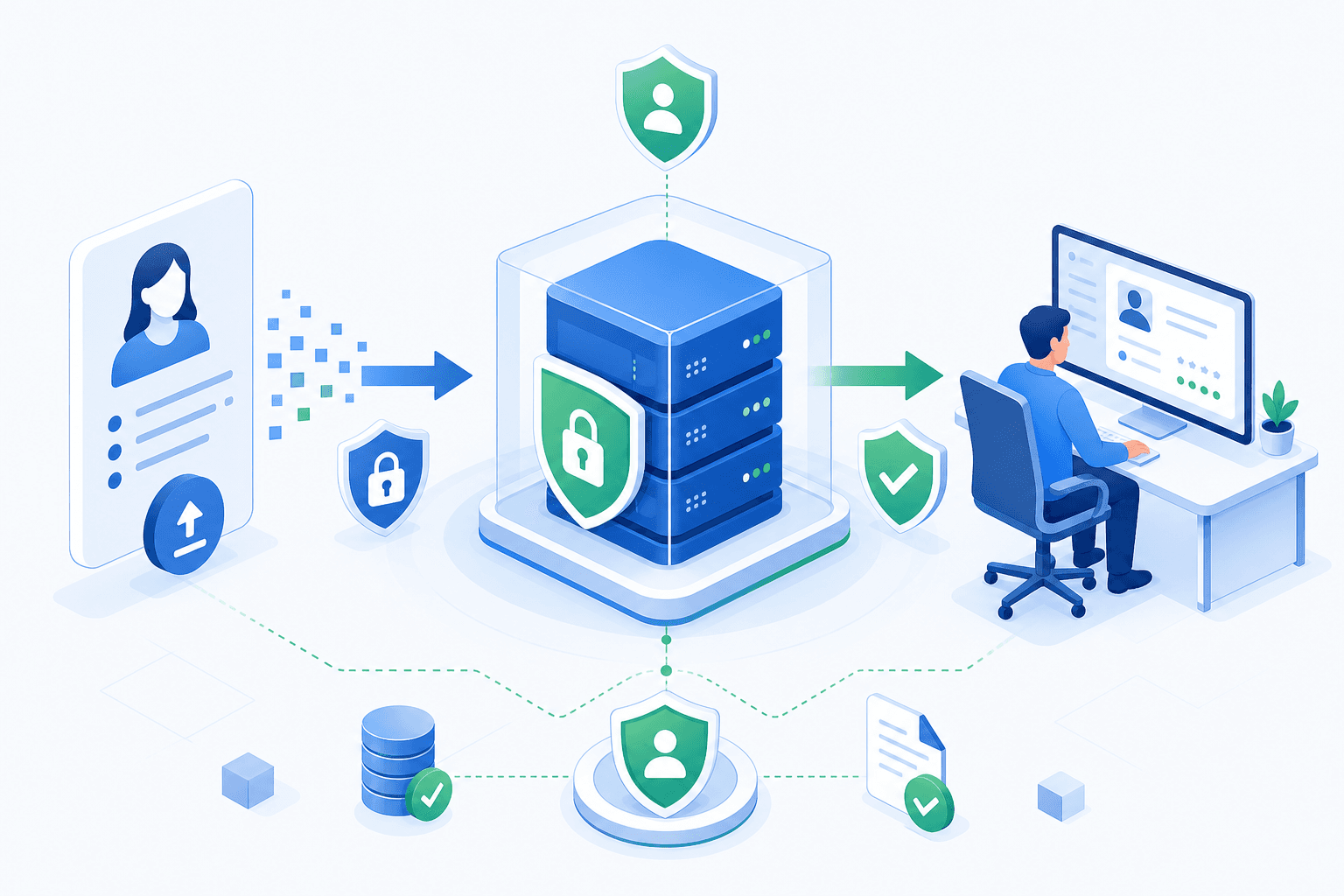
Before the candidate starts, they must receive Article 13 mandatory information — ideally in the invitation email and on the interview landing page.
- Controller identity and DPO contact.
- Purposes: pre-screening for role X, job ref.
- Legal basis: Art. 6.1.b GDPR.
- Recipients: HR, hiring manager, processor HiLucy (EU hosting if applicable).
- Retention: e.g. 6 months after process closure.
- Rights: access, rectification, erasure, restriction, objection, CNIL complaint.
- Automated evaluation existence and logic used (see Art. 22).
Article 22: automated decision nuance
Article 22 restricts decisions based solely on automated processing with legal or similarly significant effects — except contractual necessity, member-state law, or explicit consent.
AI interviews producing summaries and scores for human review are generally not purely automated decisions: recruiters read, can override scores, and decide. That is decision support.
Legal risk appears if you configure automatic rejection below a threshold without human review — prohibit that contractually and in ATS settings.
Retention, DPA, and DPIA triggers
Recommended retention: 6–12 months after the recruitment process ends for recordings and transcripts, unless legal hold or dispute. Beyond that, delete or anonymize.
Your AI vendor DPA must cover: subject and duration, data nature, documented instructions, DPIA assistance, breach notification, sub-processors, end-of-contract data return or deletion.
A DPIA is recommended — and often required — for high-risk processing: systematic large-scale candidate evaluation, potential sensitive data, or significant access-to-employment decisions.
Processing register entry example
A template entry your DPO can adapt:
Processing name: AI voice pre-screening interviews (HiLucy). Purpose: assess candidate fit against job criteria before manager interview. Legal basis: Art. 6.1.b GDPR. Data categories: identity, contact details, audio, transcript, criteria-based evaluation. Data subjects: external applicants. Recipients: HR team, hiring manager, HiLucy (processor). Retention: 6 months post-process. Security measures: encryption in transit and at rest, restricted access, logs. Transfers outside EU: none / or documented mechanism if applicable.
Key takeaway
GDPR is an operational safeguard: basis 6.1.b, Art. 13 information, Art. 22 human review, DPA and updated register — then move forward with confidence.
Frequently asked questions
Does GDPR ban AI interviews?
No. GDPR governs personal data processing: candidate information, legal basis, minimization, retention, and data subject rights. AI interviews are allowed when these principles are met.
Want to move from reading to action? See how Hi Lucy automates your voice AI interviews and your approach to interviews powered by artificial intelligence.