Myths series
The EU AI Act bans AI — true or false?
Myths series · Article 1/10
Since the European AI Act took effect, many HR and legal teams have frozen every AI project — including use cases that are already governed and deployed elsewhere in Europe. Headlines about bans and maximum fines created the impression of a total shutdown.
In reality, the AI Act does not prohibit AI in hiring. It classifies certain systems as high-risk under Annex III, category employment, workers management, and access to self-employment. This covers CV filtering, candidate ranking, and some selection tools — but subject to specific obligations, not a project stop.
For hiring leaders, the question is not whether you are allowed to use AI, but whether you are ready to document, inform, and supervise. Companies structuring compliance now turn regulatory pressure into a candidate-trust advantage.
What people say
« The EU AI Act bans AI. »
In practice
The AI Act governs high-risk HR systems through transparency, human oversight, and traceability — it does not ban them when Articles 9–15 and the application timeline are met.
Why this myth spreads
Media often reduce the law to a list of prohibited practices — subliminal manipulation, social scoring, workplace emotion recognition — without distinguishing structured pre-screening from the most sensitive systems. When a vendor says hiring is high-risk, the natural reflex is to pause everything.
Internally, confusion comes from stacking GDPR, the AI Act, and national labor law. Without a clear use-case map, HR, IT, and legal each assess a different risk and the project stalls at executive committee.
Yet lawmakers explicitly targeted high-impact access-to-employment use cases — not innovation itself. The goal is to ensure candidates know AI is involved and a human remains accountable.
Timeline to remember
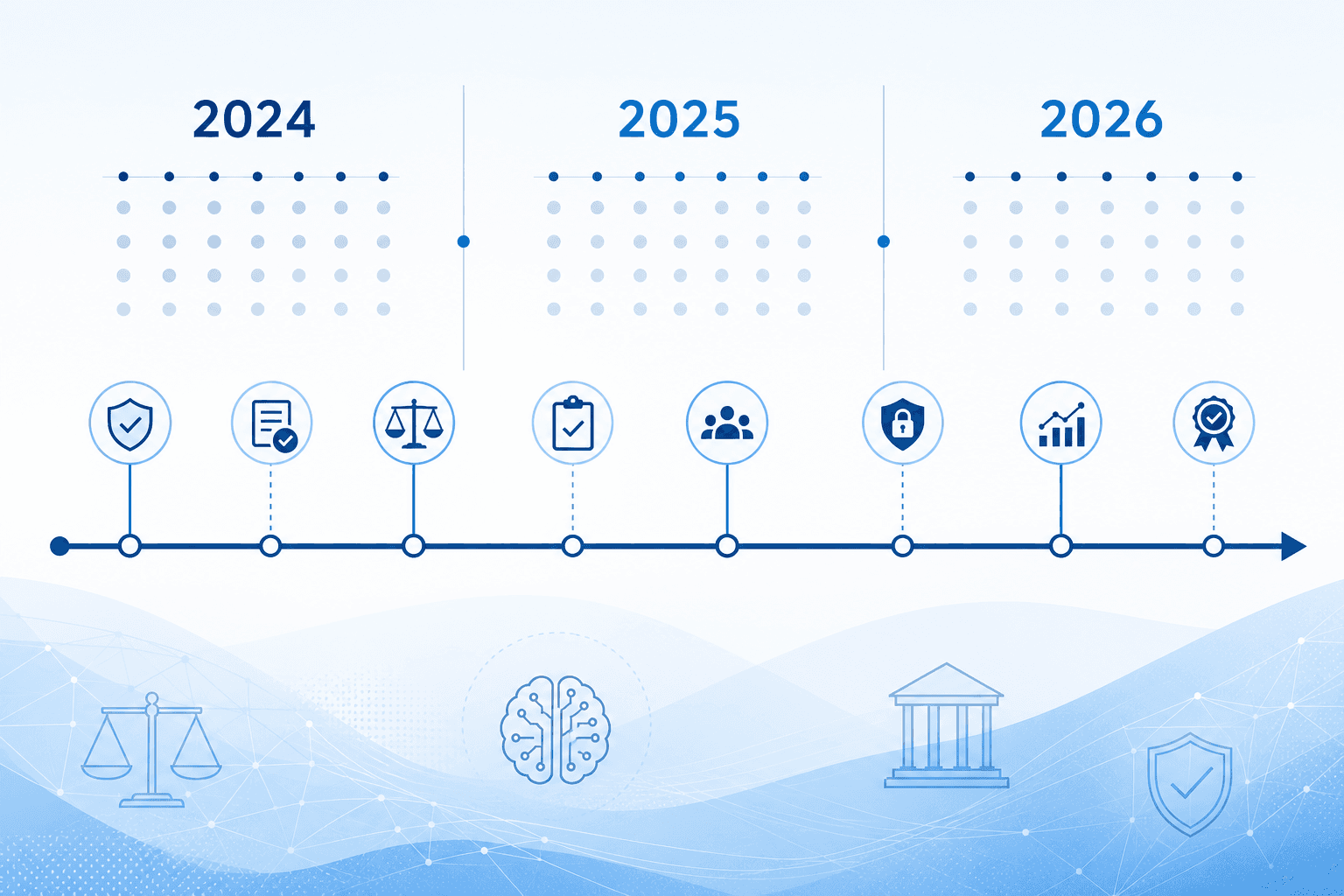
The calendar is not everything banned tomorrow. Several milestones apply at different dates depending on system type — and some hiring-related dates have been postponed.
Key point: specific obligations for recruitment AI systems (Annex III) have been postponed to 2 December 2027. By contrast, AI Literacy obligations have applied since February 2025: training and awareness for teams that use or oversee these tools does not wait until 2027.
- February 2025: prohibited practices (manipulation, social scoring, certain emotion inference) and AI Literacy.
- August 2025: GPAI obligations and value-chain governance.
- 2 December 2027: specific Annex III obligations for recruitment AI systems (postponed).
- Starting now (vendor documentation + AI Literacy) avoids a rushed rollout before 2027.
Annex III and concrete obligations (Articles 9–15)
A candidate screening or selection tool listed in Annex III must meet ongoing compliance — not a one-off checklist at contract signature.
Articles 9–15 require risk management, representative datasets, technical documentation, logs, transparency toward users and data subjects, effective human oversight, and robustness, cybersecurity, and accuracy where achievable.
- Art. 9 — Risk management: identify and mitigate bias, errors, and misuse.
- Art. 10 — Data: quality, relevance, and limits on training and inference data.
- Art. 13 — Transparency: clear deployer instructions and candidate information.
- Art. 14 — Human oversight: real ability to intervene, not fake automatic sign-off.
- Art. 15 — Accuracy and robustness: documented performance on your real use cases.
Automated CV screening vs voice pre-screening
Not all hiring AI carries the same operational risk. Mass CV filtering on proxy criteria (school, zip code, employment gaps) concentrates discrimination risk that is hard to audit afterward.
Structured voice pre-screening — as HiLucy delivers with Lucy — asks the same questions to everyone, records transcribed answers, and produces criteria-based summaries for human review. Candidates know what to expect; recruiters validate before any next step.
This is not an automatic exemption from high-risk status, but a more transparent, auditable use than opaque scoring across thousands of CVs.
Five-step compliance plan
Here is an actionable plan you can launch in half a day with HR, your DPO, and procurement.
Step 1 — Map: list every AI touchpoint (sourcing, CV filter, chatbot, voice interview, scoring). Step 2 — Classify: confirm whether the vendor qualifies the system as Annex III high-risk. Step 3 — Document: require technical documentation, conformity assessment, and instructions for use. Step 4 — Inform: add AI disclosure in job posts, invitation emails, and privacy notice. Step 5 — Supervise: define who reads summaries, within what SLA, and how decisions are logged in your ATS.
- Name an HR-side AI compliance owner (even part-time).
- Add a dedicated line in your GDPR processing register.
- Plan an annual fairness review by application source.
- Contractually require vendor documentation updates.
What CNIL guidance adds
CNIL reminds that the AI Act and GDPR are cumulative: transparency, minimization, data-subject rights, and DPIA where processing is high-risk.
For recruitment systems, CNIL stresses fair candidate information, banning irrelevant processing (e.g. emotion analysis), and human recourse for significant decisions. A vendor like HiLucy that documents flows (audio → transcript → job criteria → summary) eases DPO review.
When in doubt, involve your DPO before deployment — not after the first pilot hire.
Key takeaway
The AI Act is a trust framework, not a veto: apply AI Literacy now, anticipate the Annex III deadline of 2 December 2027, and keep humans at the center of decisions.
Frequently asked questions
Does the AI Act ban AI in recruitment?
No. The AI Act classifies some hiring tools as high-risk and requires transparency, documentation, and human oversight — without banning their use.
When does the AI Act fully apply to hiring?
Specific obligations for recruitment AI systems (Annex III) have been postponed to 2 December 2027. By contrast, AI Literacy has applied since February 2025: train your teams now.
Want to move from reading to action? See how Hi Lucy automates your voice AI interviews and your approach to interviews powered by artificial intelligence.